SUNY FACT2 May 2026 Newsletter
Chair’s letter

Dear FACT2 Campus Representatives,
As we continue our work together this year, I want to take a moment to thank you for the time, expertise, and leadership you bring to FACT2 and to your campuses across the State University of New York system.
Higher education continues to face significant change—from the rapid expansion of artificial intelligence and evolving educational technologies to shifting policies that shape how we support our students and one another. In moments like these, the work of FACT2 becomes even more important.
FACT2 remains committed to advancing teaching and learning through thoughtful innovation, meaningful collaboration, and strong faculty advocacy. We know that technology is not neutral; how we implement it matters. That means continuing to prioritize accessibility, equity, and inclusion in our digital learning environments and ensuring that all students have the opportunity to succeed.
At a time when diversity, equity, inclusion, and social justice (DEISJ) initiatives face increasing scrutiny in some spaces, our commitment remains clear: inclusive education is excellent education. Supporting diverse learners, creating equitable access, and fostering belonging are essential to the mission of public higher education and to the future of SUNY.
Your role as Campus Representatives helps ensure that faculty voices remain central in these conversations. Whether through task groups, campus initiatives, or systemwide dialogue, your insight strengthens our collective work and helps shape the future of teaching and learning across SUNY.
Thank you for your continued service, your advocacy, and your willingness to engage in this important work. I look forward to what we will accomplish together.
Warm regards,
Judith Littlejohn
Chair, Faculty Advisory Council on Teaching and Technology
Resources from the April 17 Campus Rep webinar
- Webinar video recording (1:36:26)
- SUNY Academic Services report slides (Kim Scalzo)
FACT2 Task Group Reports
SUNY FACT2 Digital Accessibility through Artificial Intelligence (AI) Task Group
Co-chairs:
SUNY FACT2 Credit for Prior Learning (CPL) through Technology-Enhanced Portfolio Assessment and Institutional Structures for Access and Equity Task Group
The task group shared this article on credit for prior learning:
- Elaine W. Leigh and Lindsay Daughtery (2025). “Eliminating Barriers to Credit for Prior Learning: What colleges can do to give students a head start.” Inside Higher Ed. October 23.
Featured 2025 FACT2 Award Recipients
Laura Parmenter
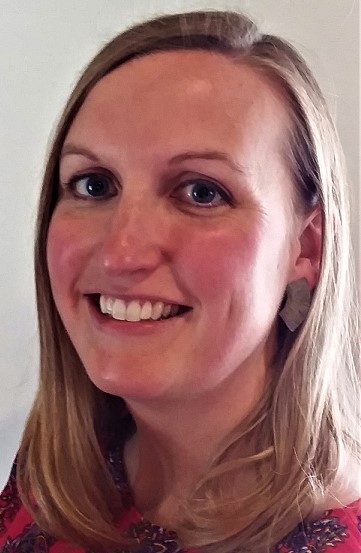
Laura developed and leads the “Teaching Students at a Distance” course, which is now key to faculty onboarding and development. The training focuses on enhancing student-faculty interactions and improving instructional quality across various teaching methods. She collaborates with the Human Resources Department to boost faculty engagement through community-building workshops. By highlighting the importance of quality interactions in online courses, she has set a new standard for online education at Jamestown Community College.
Laura’s leadership has engaged stakeholders and exceeded expectations, reflecting SUNY’s values and her commitment to instructional excellence. Her efforts have made her a catalyst for change.
Comments from her letters or recommendation for this award included:
“Her strategic, thoughtful approach fosters a culture of collaboration and continuous improvement at SUNY JCC. Her ability to balance institutional needs with faculty support has inspired innovative teaching practices and enhanced student success.”
and,
“Laura has made remarkable strides in supporting professional development, enabling
collaboration among staff, advancing partnerships within and beyond SUNY, and
providing essential resources for tech-enhanced education. Her efforts have been
instrumental in aligning institutional resources with the goal of improving student
outcomes and empowering faculty and staff to innovate in their teaching practices.”
Upstate Simulations Operations Team
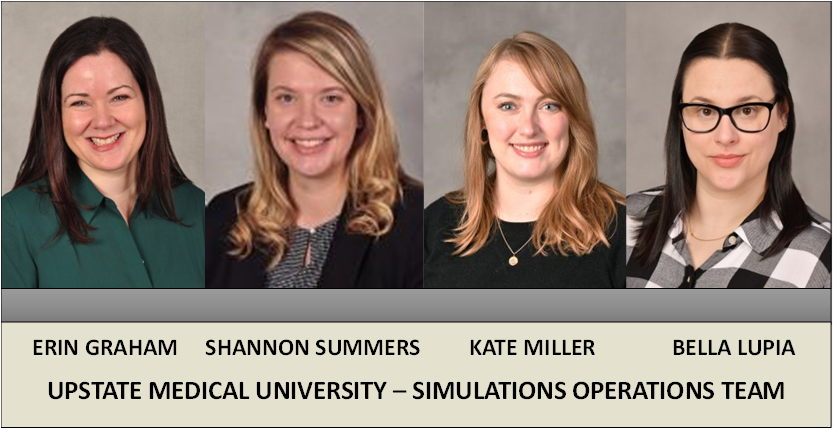
The 2025 recipient of the Excellence in Instructional Support at a State-Operated or Statutory Campus was the Simulations Operations Team of Erin Graham, Director of Simulation Operations, and Simulation Specialists, Shannon Summers, Katherine (Kate) Miller, and Ambrosia (Bella) Lupia.
The Upstate Medical University Simulation Department successfully launched a pilot program to improve interns’ skills in suicide risk assessments. Using rapid-cycle simulations with standardized patient engagements the program offers a dynamic environment for practice. Participants reported increased confidence and better communication skills. This initiative not only enhances educational experiences but also boosts patient safety and care quality. The department collaborates with faculty to ensure scenarios meet learning objectives and provides real-time feedback during simulations.
The success of these programs is a testament to the effectiveness and dedication of Erin Graham, Shannon Summers, Katherine (Kate) Miller, and Ambrosia (Bella) Lupia. Among the comments received were:
“Beyond technical execution, the Simulation Department integrates innovative technologies such as computerized mannequins for immersive, realistic scenarios. They foster interdisciplinary collaboration by involving pharmacy, behavioral healthcare teams, and others in simulation exercises. Their commitment to aligning simulations with educational objectives and providing immediate, actionable feedback while in a safe environment further enriches the learning experience.”
and,
“The Simulation Department plays a vital role in delivering high-fidelity simulation experiences that are integrated seamlessly into the curriculum of the Physician Assistant (PA) Program within the College of Health Professions, Norton College of Medicine, and College of Nursing. Their expertise in creating realistic clinical scenarios using advanced patient simulators and video technology enables learners to practice critical decision-making skills in a safe and controlled environment.”
(Note: The other 2025 FACT2 Award recipients were featured in the Fall 2025 FACT2 Newsletter.)
SUNY Conference on Instruction and Technology (CIT)
The SUNY Conference on Instruction and Technology (CIT) will take place at Stony Brook University on May 26-29, 2026. The theme of the Conference this year is: Designing the Future of Learning: Resilient Teaching, Innovative Practices, and Student Success. Registration is open for SUNY CIT 2026 until May 25, at 11:59 pm.
CIT Keynote Speakers
Sarah Rose Cavanagh

The keynote address at this conference will be provided by Dr. Sarah Rose Cavanagh, a Psychologist, Educational Developer, and author of The Spark of Learning: Energizing the College Classroom with the Science of Learning, Mind Over Monsters: Supporting Youth Mental Health with Compassionate Challenge, and numerous scholarly works.
Emily Laird

The closing address will be provided by Emily Laird, an AI Integration Technologist at the University of Wisconsin – Stout and a host of the Generative AI 101 podcast.
CIT has been SUNY’s nexus of educational technology professional development. It’s a powerful space where educators, technologists, and leaders come together to learn from each another, spark new ideas, and strengthen practices supporting our students. This year’s conference continues that tradition with a full lineup of sessions and keynotes, and pre‑conference workshops. Looking to strengthen your teaching practice? explore AI’s role in learning? enhance accessibility? expand your digital skillset? There’s a workshop designed to meet you where you are and help you grow.Just a few scheduled workshops include:
- Cross-Cultural Learning: Don’t Go It Alone!
- Preparing for Title II: Making Content Accessible in Brightspace and Microsoft Tools
- Preserving Writing as a Means of Learning
- Empowering All Learners with Technology
- Getting Up to Speed with AI for Educators
- Learn to Apply Ethical, Effective Learning with AI Using Metaliteracy
- Vibe Coding
SUNY Technology Conference (STC) 2026
What? Annual conference for SUNY faculty and staff focused on educational technology, systems, and innovation.
When? June 8 – 11, 2026
Where? Lake Placid, NY
Info? Register and get details
Tools and Resources
Accessibility and math
- The PDF 2.0 standard now supports MathML within a tagged pdf. More information is available in the PDF Association’s Best Practice Guide: Math in PDF.
- The use of TeX Live 2025 makes it possible to create accessible PDFs in Overleaf. Information on this is available at Overleaf’s page on “Creating accessible PDFs in LaTeX.”
SUNY Center for Professional Development
SUNY CPD is focused on two critical and rapidly evolving areas: artificial intelligence and accessibility. To support campuses in navigating demands and possibilities in both AI and digital accessibility, the CPD has developed and curated a set of growing on-demand resource pages, accessible on CPD homepage. Focus areas include:
- EIT Accessibility Resources: Guidance, tools, and best practices to help meet emerging accessibility requirements.
- AI Resources: Foundational information, learning opportunities, and support for integrating AI effectively and responsibly.
- Presentation Best Practices: Strategies for ensuring accessible presentations.
Want to contribute? If you have resources to share on AI and Accessibility, please send to cpdinfo@suny.edu.
Critical Perspectives Corner
Four members of the SUNY AI Fellows for the Public Good contributed 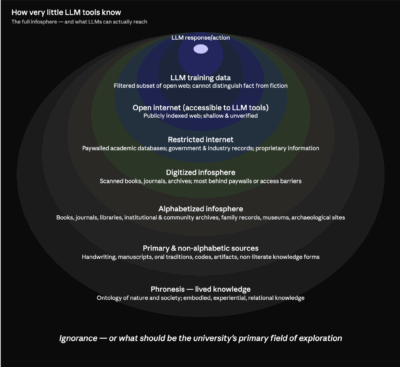 this critical-perspectives essay for this issue. Betty Feng, Shyam Sharma, Babette Faehmel, and Daniel Fernandez write that higher education is ceding ground it cannot afford to lose to a handful of private companies that are reshaping the norms of knowledge creation, teaching, and learning in ways fundamentally misaligned with the public mission of universities. The writers argue that rather than being neutral tools, LLMs are vectors of a broader ideological and economic agenda that universities have both the responsibility and the means to resist. They call on faculty, scholars, and institutional leaders to act from evidence, defend foundational principles, and make the public case for evidence-based principles and practicing based on the principles.
.
.
Resources from the SUNY AI Fellows for the Public Good
The SUNY AI Fellows for the Public Good program’s first cohort of fellows are completing their tenure this spring. This resource page features a number of curated and original materials for faculty and students. Additional resources, based on the SUNY IL-GE framework may be added in future weeks and months (SUNY has announced application for the second year/cohort of fellowships).
Initiatives Across SUNY
UDL for SUNY Project
The UDL for Student Empowerment Initiative is spearheaded by instructors Christopher D. Hromalik and Jeremy Jungbluth, with staff Lauren P. Rodriguez, Psy.D. and Meghan Martin, CPACC. Explore resources at the Universal Design for Learning at SUNY website, including:
- Hybrid and online self-paced courses
- Recordings of webinars in the website’s archives and the Access for All YouTube channel.
Neurodiversity Strategies Professional Development
Supporting Neurodiversity Across SUNY: Practical Strategies for Our Campus Communities is now available. Developed by Universal Design for Learning at SUNY, with support from CAARES: Center for Autism Advocacy and the SUNY Center for Professional Development, this systemwide training is designed to guide faculty, staff and student leaders in strengthening support for students with disabilities, with a focus on neurodiversity. Resources include self-paced online training provides practical guidance for SUNY employees and students who interact with and support students in academic, residential, and campus life settings.
- Course details and register
- Kickoff event: 4/30/26, 9:00am – Noon Eastern; Explore event details and register
SUNY and Campus Highlights
SUNY CPD
Courtnee Corcoran is the new Conference Support Specialist for SUNY Center for Professional Development (CPD). Courtnee is a graduate of SUNY-Stony Brook and previously served as Manager of Community Engagement for the CPD.
SUNY Rockland
Our campus has recently developed a generative AI policy for faculty and students, which is currently pending approval by the Faculty Senate and the Board of Trustees. We have also hosted a series of AI workshops to provide faculty with opportunities to share their experiences using AI in the classroom. In addition, we continue to focus on improving the digital accessibility of our instructional materials. (submitted by Xin Ye)
FACT2 Campus Rep Engagement Committee
This newsletter was assembled by the FACT2 campus rep engagement committee: Melissa Bartlett, Andrea Gilbert, Kathleen Gradel, John Kane, Judith Littlejohn, and Shyam Sharma. If you would like to join this committee or contribute to future newsletters, please contact Kathleen Gradel or John Kane